The Flex Market Is Changing: Why Management Agreements Are Taking Over
The Flex Market Is Changing: Why Management Agreements Are Taking Over
The flexible office market is changing.
And one of the most significant changes is happening behind the scenes - in the way flex operators and landlords structure their relationships.
Savills’ latest analysis of the European flex market highlights a major shift towards management agreements and hybrid lease structures.
According to Savills, the proportion of operators expanding through management agreements and hybrid leases increased from 45% in 2023 to 63% in 2025.
In the UK, the shift has been even more dramatic: 46% → 78% in just two years.
Savills expects the European figure to exceed 70% during 2026, with landlords in markets such as Germany, France and Poland increasingly considering management agreements.
So what is driving this change? And what are the different models available to landlords and flex operators?
The traditional model: the lease
Historically, the relationship has been relatively straightforward.
Landlord → Operator → Occupier
The operator takes a lease on a building, invests in the fit-out, operates the space and takes the commercial risk.
The landlord receives rent. The operator keeps the upside - but also takes the downside.
This model still has an important role to play, particularly where an operator has confidence in the location and is prepared to commit capital.
But it can create a significant mismatch between the landlord and operator: the landlord wants a reliable long-term income. The operator wants flexibility and the ability to respond to market conditions.
And the operator has to fund the fit-out and carry the risk of filling the building.
Management agreements
This is where management agreements come in. Rather than leasing the building, the operator manages the flexible workspace on behalf of the landlord.
The landlord retains ownership of the property and typically funds some or all of the initial investment.
The operator provides the expertise:
-
Workspace design and specification
-
Branding
-
Sales and marketing
-
Occupier acquisition
-
Day-to-day operations
-
Technology
-
Community management
-
Pricing and revenue management
The landlord receives the operating income, with the operator receiving a management fee and potentially an incentive based on performance.
The important difference is that the landlord retains more of the economic upside - and more of the operating risk.
For landlords who believe in the flex opportunity but don't want to build their own operating platform, this can be an attractive proposition.
Hybrid leases
Then there is the middle ground: a hybrid lease combines elements of a traditional lease with a management or profit-share structure.
The operator might pay:
A base rent + a percentage of revenue or profit.
This gives the landlord a degree of income security while allowing the operator to participate in the upside.
For example:
-
Base rent provides the landlord with a minimum level of income.
-
Profit or revenue share allows both parties to benefit if the flex operation performs strongly.
This model can be particularly attractive where both parties want some protection but don't want to take all of the risk themselves.
Profit-share agreements
Another model is a more straightforward profit-share arrangement. Instead of the operator paying a conventional rent, the parties agree how the operating profits will be divided.
This creates much greater alignment. If the centre performs well, both parties benefit. If performance is weaker, both parties feel the impact.
The challenge is that these structures require considerably more transparency around:
-
Operating costs
-
Capital expenditure
-
Revenue recognition
-
Management costs
-
Marketing expenditure
-
Profit calculations
The agreement needs to be very clear about what constitutes "profit".
Landlord-operated flex
There is also a fourth option: The landlord operates the flex business themselves.
The landlord effectively becomes the operator. They control the brand, customer acquisition, pricing, staffing and operation. This gives the landlord maximum control and potentially maximum return.
But it also means taking on the greatest operational risk. For many property owners, this is not their core competency - which is one reason specialist flex operators remain so important.
So why is the market moving towards management agreements?
There are several reasons.
- Risk is being shared
-
The traditional lease puts much of the property and operational risk on the operator.
-
Management agreements distribute that risk differently.
-
The landlord participates in the operating performance rather than simply collecting rent.
- Landlords want the upside
-
If flex space can generate significantly more income than a conventional lease, landlords increasingly want a share of that upside.
-
They don't necessarily want to give away the entire economic benefit to an operator in return for a fixed rent.
- Operators want to grow without taking on huge liabilities
-
For operators, management agreements can provide a way to grow their network without taking a long lease on every building.
-
They can expand their brand and operating platform without tying up as much capital and balance sheet capacity.
- The market is becoming more sophisticated
-
Flex is no longer simply: "Take a building → fit it out → rent desks."
-
It is becoming a sophisticated operating business involving revenue management, technology, customer acquisition, hospitality, workplace services and increasingly complex real estate structures.
-
That makes the relationship between landlord and operator much more strategic.
There isn't one "best" model
This is perhaps the most important point. The right structure depends on the building, location, capital available, operator, expected demand and appetite for risk.
A simple way of looking at the options is:
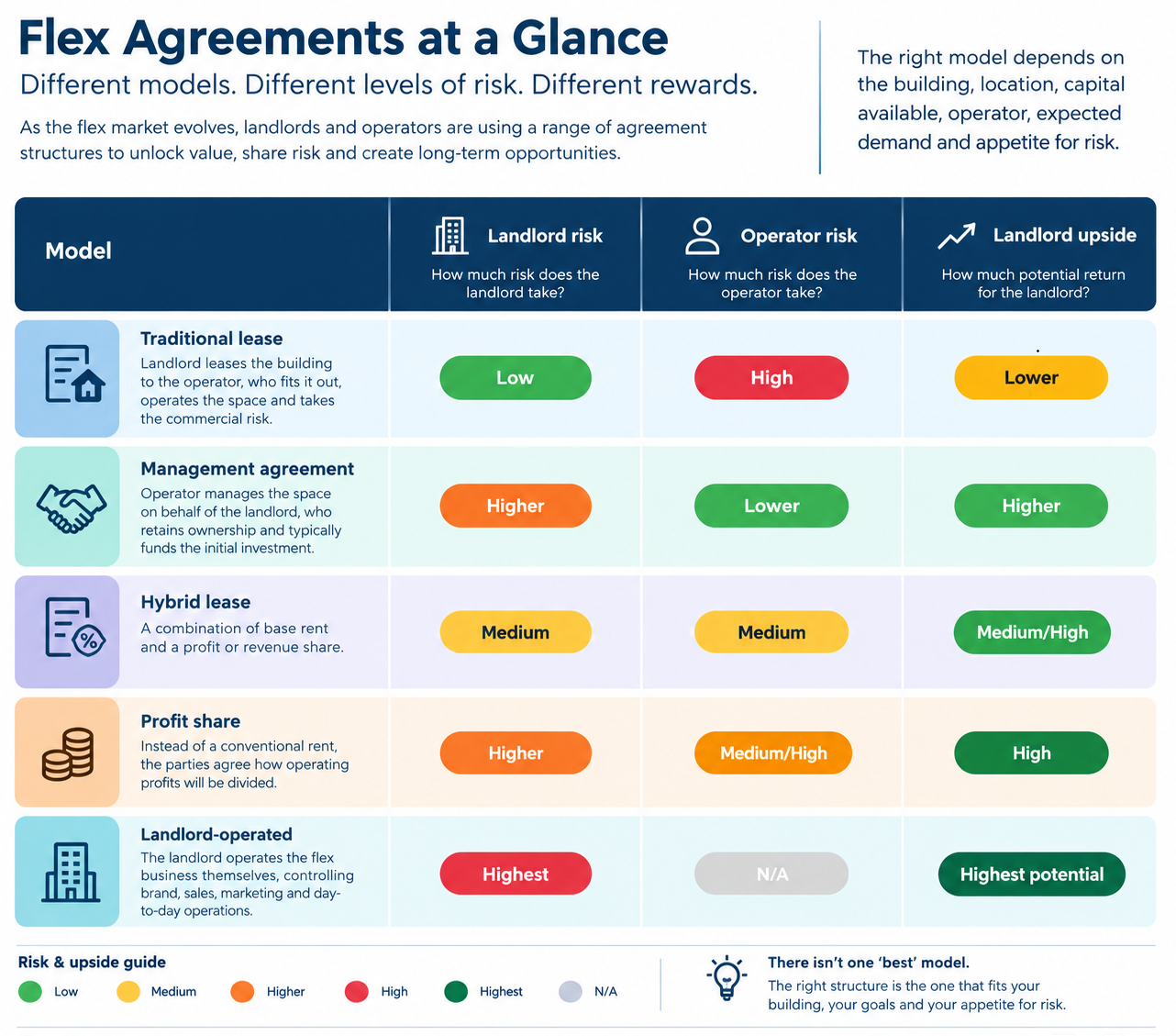
The future of flex is therefore unlikely to be dominated by one structure.
Instead, we are likely to see more creative agreements designed around the specific circumstances of each building.
What this means for landlords
For landlords sitting on vacant, under-utilised or difficult-to-let office space, the question is increasingly not:
"Who will lease my building?"
It is:
"What is the best operating model for my building?"
-
Should I lease it?
-
Should I bring in an operator?
-
Should I share the risk?
-
Should I share the profits?
-
Should I fund the fit-out?
-
Should I retain control of the customer relationship?
These are fundamentally different questions.
And the answers can have a significant impact on the long-term value and income potential of the asset.
Savills' numbers suggest that the industry is already voting with its feet.
The move from 46% to 78% in the UK in just two years is not a minor change to lease structures.
It represents a fundamental shift in the relationship between property owners and flex operators.
The next phase of flexible workspace may therefore be less about who takes the lease - and much more about who operates the space, who funds it, who takes the risk and who shares the reward.