Flexible Office, Serviced Office, Managed Office… What’s the Difference
Flexible Office, Serviced Office, Managed Office… What’s the Difference?
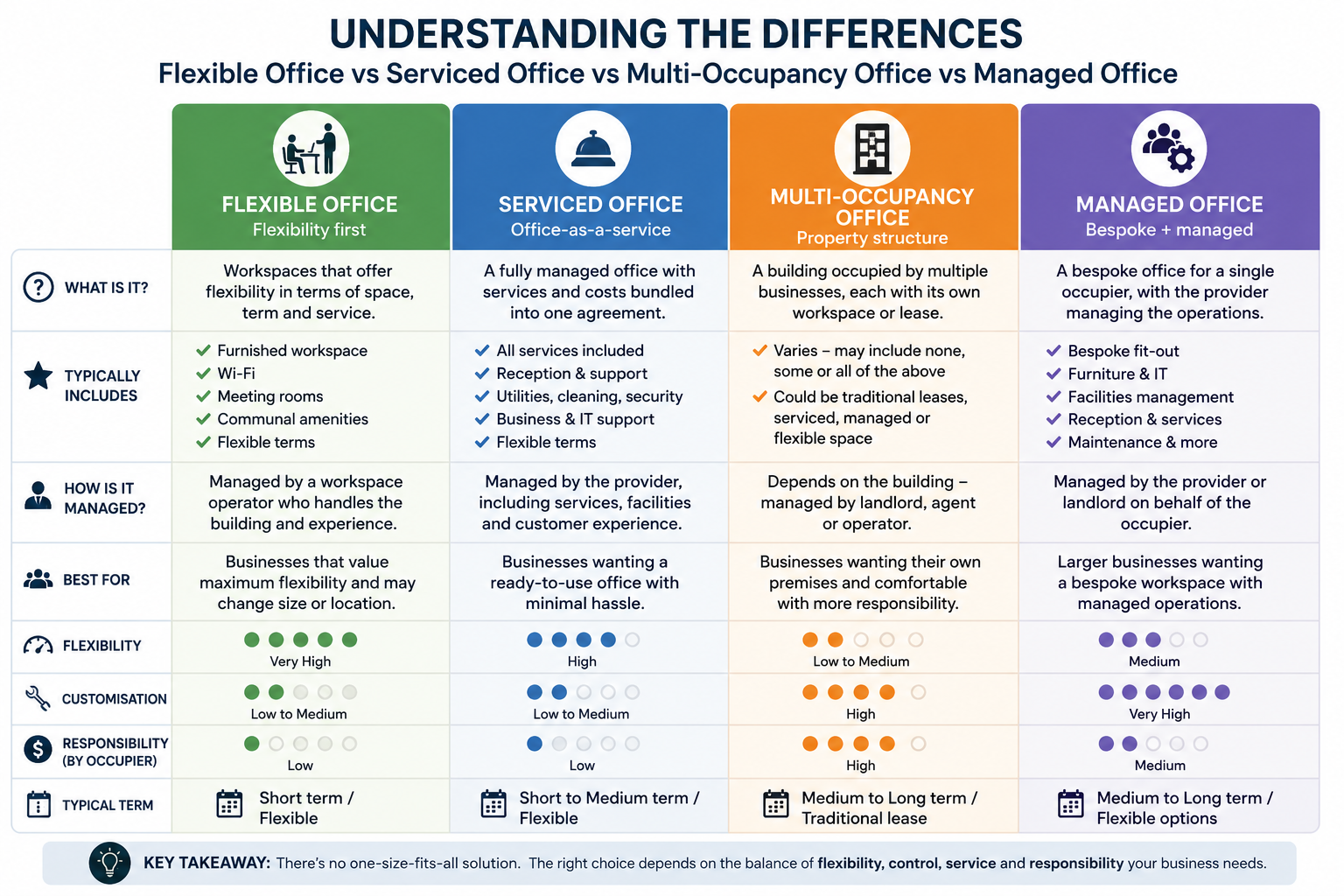
“Flexible office space” is often used as an umbrella term for almost everything that isn’t a traditional leased office.
But flexible, serviced, multi-occupancy and managed offices are not necessarily the same thing - and choosing the wrong model can mean paying for services you don't need, or ending up with an office that doesn't work for your business.
Here’s a simple guide.
Flexible Office
What is it?
An office solution designed to provide flexibility around space, term and cost.
This could include coworking, hot desks, private offices, team suites or flexible memberships.
Typically includes:
-
Shorter or flexible contract terms
-
Furnished workspace
-
Wi-Fi
-
Meeting rooms
-
Reception/business support
-
Kitchen/breakout areas
-
Access to communal amenities
-
Utilities and building services bundled into the price
How is it managed?
Usually by an operator who manages the building, workspace and customer experience.
Best for: Businesses that value flexibility and simplicity, particularly those whose space requirements may change.
Serviced Office
What is it?
A fully managed office where many of the costs and services associated with occupying conventional premises are bundled into one agreement.
Typically includes:
-
Fully furnished office
-
Reception services
-
Internet
-
Utilities
-
Cleaning
-
Security
-
Meeting rooms
-
Breakout areas
-
Business services
-
IT support
-
Flexible terms
You are effectively buying an office-as-a-service rather than taking on a traditional commercial lease.
How is it managed?
The workspace provider manages the building, services, facilities and often the day-to-day customer experience.
Best for: Businesses wanting a ready-to-use office with minimal operational hassle.
Multi-Occupancy Office
What is it?
A building or property occupied by multiple businesses, each with its own workspace or office.
This is an important distinction: multi-occupancy describes the property structure, not necessarily the service proposition.
A multi-occupancy building could contain:
-
Traditional leased offices
-
Serviced offices
-
Managed offices
-
Flexible workspace
-
A mixture of all four
How is it managed?
It depends on the building. A landlord may manage it directly, appoint a managing agent, or use a workspace operator.
Best for: Businesses that want their own dedicated premises but are comfortable taking responsibility for more of the operational requirements.
Managed Office
What is it?
A managed office sits somewhere between a traditional lease and a serviced office.
The occupier typically gets a dedicated office designed around its requirements, but the workspace provider or landlord takes care of many of the operational responsibilities.
This can include:
-
Bespoke fit-out
-
Furniture
-
IT and connectivity
-
Cleaning
-
Reception
-
Utilities
-
Facilities management
-
Meeting rooms
-
Security
-
Catering/hospitality
-
Maintenance
The big difference is that the office is often configured specifically for the occupier, rather than being an existing standard office.
Best for: Larger businesses that want their own branded, bespoke workplace without taking on all the responsibilities of a conventional lease.
So which should you choose?
There isn't a universally "best" option.
It depends on what you're trying to achieve.
Choose flexible workspace if:
👉 Your headcount or space requirements are likely to change.
👉 You want maximum flexibility.
👉 You may need different types of workspace.
Choose a serviced office if:
👉 You want to move in quickly.
👉 You want most costs bundled together.
👉 You don't want to manage the office yourself.
Choose a multi-occupancy building if:
👉 You want your own premises.
👉 You are comfortable taking on more responsibility.
👉 You don't necessarily need a fully serviced proposition.
Choose a managed office if:
👉 You need a larger or bespoke workspace.
👉 You want your own identity and configuration.
👉 You want someone else to manage the operational side.
The important question isn't simply:
"Which type of office is cheapest?"
Instead, ask:
"Which solution gives us the right combination of cost, flexibility, control, service and responsibility?"
Because the cheapest headline rent isn't necessarily the cheapest workplace.
And the most flexible solution isn't necessarily the one that gives your business the flexibility it actually needs.
At FlexSpace Consulting, we help businesses understand the market, compare the options and find the workspace solution that genuinely fits their requirements.